
Free Consultation
Free Consultation
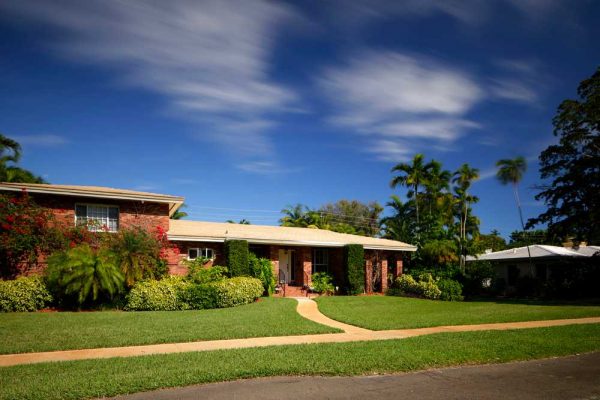
HOA dispute mediation is a confidential process in which a neutral mediator helps homeowners and homeowners’ association boards negotiate a binding settlement without filing a lawsuit.
Joseph P. Farina, retired Chief Judge of the 11th Judicial Circuit and Florida Supreme Court Certified Circuit Civil Mediator, mediates HOA disputes at the JAMS Resolution Center, 600 Brickell Avenue, Suite 2600, Miami, FL 33131.
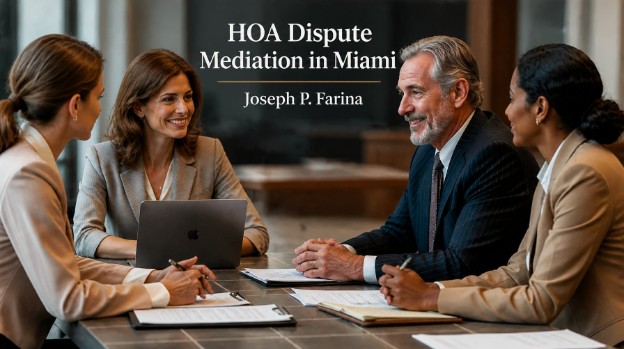
Florida Statutes Section 720.311 requires mandatory presuit mediation for most HOA-homeowner disputes before either party can file a lawsuit — making mediation the legally required first step toward resolution.
An unresolved HOA conflict affects your property value and daily life — schedule a mediation with Judge Farina to reach a binding agreement before the dispute escalates to litigation.
HOA mediation in Miami-Dade County resolves disputes between homeowners and association boards across residential communities, condominiums, and planned developments.
| Dispute Category | Common Scenarios |
| Covenant enforcement | Unapproved exterior modifications, landscaping violations, parking restrictions, and pet policy breaches |
| Assessment and fee disputes | Special assessment challenges, delinquent maintenance fees, disputed late charges |
| Board governance conflicts | Improper meeting notice, denied records access, election irregularities, and quorum failures |
| Architectural review disputes | Denied renovation applications, inconsistent approval standards, and selective enforcement |
| Common area maintenance | Failure to repair shared infrastructure, deferred maintenance, and amenity access restrictions |
| Neighbor-to-neighbor conflicts | Noise complaints, property line encroachments, and nuisance claims escalated to the board |
| CC&R amendment disputes | Disagreements over proposed changes to covenants, conditions, and restrictions |
Florida’s managed communities — including HOAs governed by Chapter 720 and condominium associations governed by Chapter 718 — generate thousands of disputes each year.
HOA-homeowner conflicts are a routine feature of Florida’s densely governed communities, and Miami-Dade County’s concentration of planned developments amplifies that volume.
Florida Statutes § 720.311(2)(a) requires mandatory pre-suit mediation for specific categories of HOA disputes before either party can file a lawsuit. The statute covers:
The presuit mediation process follows strict procedural requirements:
Failure to respond within 20 days, agree on a mediator, pay required fees, or attend a scheduled session constitutes refusal to participate — which authorizes the other party to proceed to court and seek recovery of mediation-related costs and fees.
A party that refuses to participate is also barred from recovering attorney fees in subsequent litigation.
Disputes exempt from presuit mediation under § 720.311 include collection of assessments, fines, or other financial obligations; enforcement of a prior mediation settlement agreement; and election or recall disputes (which must be resolved through DBPR arbitration or court action).
In the 2026 Florida legislative session, HB 657 proposed eliminating the § 720.311 presuit mediation requirement and replacing it with a new Community Association Court Program.
The bill passed the Florida House 108–2 on March 5, 2026, but died in the Senate Rules on March 13, 2026. The presuit mediation requirement remains in full effect as of July 2026.
An HOA mediation demand carries strict deadlines you cannot afford to miss — contact Judge Farina’s office to prepare your case before the 20-day response window closes.
Joseph P. Farina conducts HOA mediations at the JAMS Resolution Center on Brickell Avenue and offers virtual sessions through Zoom, Microsoft Teams, and WebEx. The process follows four stages:
All discussions during mediation are privileged and confidential under Florida law and are conducted in accordance with the Florida Rules of Civil Procedure.
Information revealed during mediation cannot be used in subsequent litigation if the mediation does not result in a settlement.
Florida law provides two alternative dispute resolution paths for HOA and condominium disputes: mediation under § 720.311 and nonbinding arbitration through the DBPR Division of Florida Condominiums, Timeshares, and Mobile Homes under § 718.1255.
| Factor | Mediation (§ 720.311) | DBPR Arbitration (§ 718.1255) |
| Applies to | HOA disputes under Chapter 720 | Condo disputes under Chapter 718; also available as an alternative to mediation |
| Decision-maker | Parties control the outcome | The arbitrator renders a decision |
| Binding nature | Binding only if the parties sign a settlement | Nonbinding unless parties agree in advance; either side can request a trial de novo within 30 days |
| Confidentiality | Fully confidential and privileged | Hearing records may become public |
| Cost sharing | Split equally unless otherwise agreed | Filing fees plus arbitrator costs |
| Timeline | Must occur within 90 days of demand | Varies; DBPR administers the schedule |
| Presuit requirement | Mandatory for HOA covenant, records, and meeting disputes | Required for condo disputes involving board authority, elections, and unit owner obligations |
For condominium association disputes, § 718.1255 allows unit owners to choose between nonbinding DBPR arbitration and presuit mediation following the § 720.311 process.
This flexibility, introduced by the 2021 legislative amendments, provides condo owners with a mediation option previously unavailable.
Mediation works best when both parties want to preserve their living relationship within the community and when the dispute involves subjective judgment calls — architectural review decisions, selective enforcement claims, or maintenance disagreements — where a negotiated compromise serves both sides better than a third-party ruling.
Joseph P. Farina brings credentials that distinguish him among Florida HOA mediators:
HOA disputes carry an emotional dimension that most commercial disputes lack — homeowners live in the same community as their opponents, attend the same board meetings, and share the same amenities.
Judge Farina’s approach addresses the relational dynamics beneath the legal positions, working toward settlements that allow both sides to continue living as neighbors after the dispute is resolved.
Florida governs homeowners associations and condominium associations under separate statutory frameworks with distinct dispute resolution requirements.
| Element | HOA (Chapter 720) | Condominium (Chapter 718) |
| Governing statute | Florida Statutes Chapter 720 | Florida Statutes Chapter 718 |
| Presuit requirement | Mandatory mediation under § 720.311 | Nonbinding arbitration via DBPR or mediation under § 720.311 (owner’s choice since 2021) |
| Common area ownership | Owned by the HOA as an entity | Owned collectively by all unit owners |
| Regulatory oversight | Limited DBPR jurisdiction | DBPR Division of Condominiums has broader authority |
| Assessment liens | Foreclosable under § 720.3085 | Foreclosable under § 718.116 |
| Records access | § 720.303 — 10 business days to produce | § 718.111 — records must be available within the time specified by statute |
| Election/recall disputes | Must go to court or DBPR | Must go to DBPR arbitration |
Many Miami-Dade communities include both HOA-governed single-family neighborhoods and condo-governed towers within the same master association.
Disputes in these mixed communities sometimes involve overlapping jurisdiction between Chapter 718 and Chapter 720, making experienced mediation with a neutral like Judge Farina essential for identifying which statutory framework applies and structuring a resolution that accounts for both sets of governing documents.
For most HOA disputes in Miami-Dade County, the choice between mediation and litigation is not optional — § 720.311 requires mediation first for covenant enforcement, records access, governing document amendments, and meeting disputes.
Litigation becomes available only after mediation has been attempted or after the opposing party has refused to participate.
Mediation offers advantages that litigation structurally cannot match for community disputes:
Litigation remains necessary when one party refuses to participate in mediation, when emergency injunctive relief is required (such as halting unauthorized construction that threatens structural integrity), or when the dispute involves fraud, breach of fiduciary duty, or criminal misconduct by board members.
What is HOA mediation and how does it work in Florida?
HOA mediation is a confidential process in which a neutral mediator facilitates negotiations between homeowners and the homeowners’ association board. Florida Statutes § 720.311 mandates presuit mediation for covenant enforcement disputes, records access disputes, and governing document amendment disputes before either party files a lawsuit.
Does Florida require mediation before suing an HOA?
Florida Statutes § 720.311 requires mandatory pre-suit mediation for disputes involving covenant enforcement, common area use, governing document amendments, board meetings, and access to official records. Assessment collection, fines, and election or recall disputes are exempt from the presuit mediation requirement.
How long does a homeowner have to respond to an HOA mediation demand in Florida?
A party receiving a presuit mediation demand under § 720.311 has 20 days from the date of mailing to serve a written response by certified mail. Failure to respond within 20 days authorizes the aggrieved party to proceed directly to court and seek cost recovery.
What types of HOA disputes qualify for presuit mediation in Florida?
Qualifying disputes include covenant enforcement actions, use of or changes to parcels and common areas, governing document amendments, board and committee meeting disputes (excluding elections), and access to official association records, including financial statements, minutes, and contracts.
How much does HOA mediation cost in Miami-Dade County?
Under § 720.311, both parties share mediation costs equally unless otherwise agreed. An average HOA mediation session requires three to four hours of mediator time, including preparation. Each party also pays its own attorney fees, though attorney representation is optional under the statute.
Is an HOA mediation settlement agreement legally binding in Florida?
A signed mediation settlement agreement is a legally binding contract enforceable in Florida circuit court. If either party fails to comply with the settlement terms, the other party may petition the court for enforcement without filing a separate breach-of-contract action.
What happens if an HOA refuses to participate in presuit mediation?
Under § 720.311, failure to respond to a mediation demand, agree on a mediator, pay required fees, or attend a scheduled session constitutes refusal. The aggrieved party may then file a lawsuit and seek mediation-related costs, and the refusing party loses its right to recover attorney fees.
Can HOA mediation be conducted virtually in Miami?
Joseph P. Farina conducts virtual HOA mediations via Zoom, Microsoft Teams, and WebEx, with the same confidentiality protections as in-person sessions at the JAMS Resolution Center. Virtual mediation allows board members, homeowners, and attorneys to participate from anywhere in Florida.
What is the difference between HOA mediation and DBPR arbitration in Florida?
HOA mediation under § 720.311 is a party-controlled negotiation resulting in a binding settlement only if both sides agree. DBPR arbitration under § 718.1255 involves an arbitrator who renders a nonbinding decision — either side can request a court trial within 30 days of the ruling.
What qualifications should an HOA mediator have in Florida?
A qualified Florida HOA mediator holds Florida Supreme Court Circuit Civil Mediator Certification and demonstrates experience with Chapter 720 governance disputes, CC&R enforcement, assessment conflicts, and board meeting procedural issues. Judicial bench experience adds the ability to assess likely court outcomes.
A dispute with your HOA board threatens your property value and peace of mind — contact Judge Farina at 305-371-5267 to schedule a mediation to resolve the conflict and preserve your community.

