
Free Consultation
Free Consultation

Commercial arbitration is a private dispute resolution process businesses use to resolve contract, partnership, shareholder, and joint venture disputes outside of court, ending in a binding decision called an award.
Business owners in Miami-Dade County use commercial arbitration when a contract requires it or when the parties want a resolution process outside the public court system.
Business owners weighing a courtroom fight over a broken partnership or a breached contract can request a consultation on commercial arbitration to determine whether their governing agreement already requires it.
Commercial arbitration proceeds when two or more businesses present evidence and argument to a neutral arbitrator, who then issues a binding decision.
Businesses use commercial arbitration instead of litigation when their contract, partnership agreement, or shareholder agreement contains an arbitration clause.
The process takes place outside the public court system, though the parties’ confidentiality obligations and the actual timeline depend on the arbitration agreement and the case’s complexity.
Miami-Dade businesses most often turn to commercial arbitration for breach-of-contract claims, partnership breakups, shareholder disputes, and joint venture disputes.
An arbitrator with judicial experience, such as retired Chief Judge Joseph P. Farina, Florida Supreme Court Qualified Arbitrator at JAMS, brings the same evidentiary discipline as a courtroom while keeping the proceeding outside the public court docket.
Commercial arbitration follows a structured sequence: notice, arbitrator selection, hearing, and award. A party initiates the process by giving written notice of the dispute to the opposing party, describing the controversy and the remedy sought; this notice starts the process without a formal court filing.
Once the arbitrator is appointed, either through the parties’ contract or JAMS’s case assignment process, the case proceeds to a hearing where both sides present evidence under relaxed rules compared to civil court.
Following the hearing, the arbitrator issues a written award, allowing the business to act on a final decision rather than wait on a crowded court calendar.
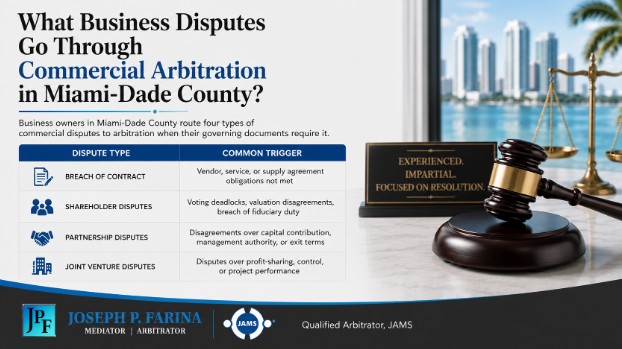
Business owners in Miami-Dade County route four types of commercial disputes to arbitration when their governing documents require it.
| Dispute Type | Common Trigger |
| Breach of contract | Vendor, service, or supply agreement obligations not met |
| Shareholder disputes | Voting deadlocks, valuation disagreements, breach of fiduciary duty |
| Partnership disputes | Disagreements over capital contribution, management authority, or exit terms |
| Joint venture disputes | Disputes over profit-sharing, control, or project performance |
These four dispute types don’t share the same underlying legal framework, even though the same arbitration clause can govern all of them.
Shareholder disputes generally arise under Florida’s corporate governance framework, while partnership disputes follow different default rules depending on whether the business operates as a general partnership, limited partnership, or LLC.
Joint venture disputes often fall somewhere between the two, since Florida courts sometimes treat a joint venture as a form of partnership depending on how the parties structured their agreement.
An arbitration clause in the entity’s bylaws, partnership agreement, or operating agreement generally governs the dispute regardless of which underlying framework would otherwise apply, since Chapter 682 makes a written arbitration agreement enforceable on its own terms — subject to the same validity and scope questions addressed in an arbitrability challenge below.
Before a dispute reaches arbitration, a business should locate several provisions in its existing arbitration clause: the named governing rules (such as JAMS’s Comprehensive Arbitration Rules), the method for selecting the arbitrator, the number of arbitrators required, the venue or seat of arbitration, any fee-allocation language, and the specific scope of disputes the clause covers.
These provisions determine how the case is administered and can affect cost, timeline, and which disputes actually fall within the clause.
A party can challenge whether a specific dispute falls within the scope of an arbitration clause, a threshold fight known as an arbitrability challenge.
This is a common opening move in shareholder and partnership disputes, in which one side argues that the underlying claim, such as a fraud or oppression allegation, was never intended to be covered by the arbitration clause in the first place.
Florida law splits this decision between the court and the arbitrator.
A court decides whether an agreement to arbitrate exists at all or whether a given controversy is subject to that agreement, while an arbitrator decides whether a condition precedent to arbitrability has been met and whether the contract containing the arbitration clause is otherwise enforceable, under Section 682.02.
This statutory default allocation can be modified where the parties’ agreement or an incorporated set of arbitration rules expressly assigns arbitrability questions to the arbitrator instead, so a business should review both its arbitration clause and any referenced rules — such as JAMS’s Comprehensive Arbitration Rules — rather than assume the statutory default applies.
A business facing an arbitrability challenge should expect this threshold question to be resolved before the underlying dispute is heard on the merits.
A business can seek emergency court relief before an arbitrator is appointed, so a partner cannot drain accounts or transfer assets while the case is still being set up.
Florida law allows a court to enter provisional remedies to protect the effectiveness of the arbitration proceeding, to the same extent as if the dispute were a civil action, under Section 682.031.
Once the arbitrator is appointed and able to act, that authority shifts: the arbitrator can then issue provisional remedies, including interim awards, to protect the arbitration and promote a fair and expeditious resolution.
A party may still return to court for a provisional remedy after the arbitrator is seated, but only if the matter is urgent and the arbitrator cannot act in time or cannot provide an adequate remedy.
Commercial arbitration costs compare differently to business litigation costs depending on the case: arbitration’s fixed filing and case-management fees are known in advance, while litigation’s discovery and multi-year calendar can add unpredictable attorney-hour costs.
Arbitration’s own attorney and arbitrator’s hourly fees can also become substantial in a complex or multi-day case, so costs are not automatically lower in every matter.
| Fee Component | Amount |
| Filing fee — two-party matter | $2,000 |
| Filing fee — three or more parties | $3,500 |
| Case Management Fee | 13% of all professional fees billed |
| Arbitrator professional/hourly fee | Set individually by the arbitrator |
The JAMS fee figures above come from JAMS’s published Fee Schedule. Under JAMS’s Comprehensive Arbitration Rules, Rule 31(a), each party generally pays a pro rata share of these fees and expenses unless the parties agree to a different allocation.
A commercial arbitration award carries the same enforceability as a court judgment once confirmed. Florida’s Revised Arbitration Code, Section 682.02 of the Florida Statutes, makes a written agreement to arbitrate valid, enforceable, and irrevocable except on grounds available at law or in equity to revoke any contract; a business generally cannot disregard a valid arbitration clause once a dispute arises, though it may still raise the arbitrability challenges described above.
Either party may petition the court to confirm the award under Section 682.12, converting it into an enforceable judgment.
Courts vacate awards only on narrow grounds, such as evident partiality or arbitrator misconduct, under Section 682.13. This narrow standard means a losing party generally cannot relitigate the same facts in court after an unfavorable award.
A business should choose arbitration when it needs a binding decision issued outside the public court record. Confidentiality protection for trade secrets and other sensitive information is not automatic — it depends on the arbitration agreement and applicable JAMS rules — so a business with especially sensitive information should confirm the scope of confidentiality in its clause before relying on arbitration for that purpose.
Mediation works better when both sides are still willing to negotiate a settlement rather than have a decision imposed on them.
Shareholder disputes involving allegations of fraud or oppression sometimes call for the broader discovery tools of litigation rather than the narrower fact-finding process of arbitration. A business facing serious allegations of misconduct should weigh arbitration’s more limited discovery against litigation’s more expansive evidence-gathering options before relying on an existing arbitration clause.
Businesses with an existing arbitration clause in their partnership agreement, shareholder agreement, or vendor contract generally proceed directly to arbitration once negotiation stalls, following the path the parties already agreed to rather than defaulting to court.
Businesses with a stalled shareholder or partnership dispute can request a commercial arbitration consultation to confirm whether their governing agreement already requires arbitration before filing suit.
What is the difference between commercial arbitration and commercial litigation? Commercial arbitration resolves disputes outside the public court system through a neutral arbitrator who issues a binding award, while litigation resolves disputes through a public court process with full appellate review. Arbitration proceedings and case files are not part of the public court record, though confidentiality of specific case details depends on the arbitration agreement and applicable rules.
Does a business contract need an arbitration clause to use arbitration? Most commercial arbitrations proceed under a pre-existing arbitration clause in the parties’ contract, partnership agreement, or shareholder agreement. Parties without such a clause can still arbitrate if they sign a new agreement after the dispute arises, designating an arbitrator and the governing rules.
Can a shareholder dispute go to arbitration in Florida? Shareholder disputes can go to arbitration when the corporation’s bylaws or a shareholder agreement contains an arbitration clause covering the disagreement. Common shareholder disputes suited to arbitration include voting deadlocks, valuation disputes, and breach-of-fiduciary-duty claims.
How long does commercial arbitration take compared to a lawsuit? Arbitration timelines vary by case complexity: a single-issue contract dispute can resolve in a matter of months, while shareholder, partnership, or joint venture disputes involving valuation experts or multiple hearing days often take longer. Florida civil litigation timelines vary, and a precise comparison depends on each case’s complexity, discovery scope, and the court or arbitrator’s calendar.
Who pays the arbitrator’s fees in a commercial arbitration? Each party typically pays a pro rata share of the filing fee, case management fee, and the arbitrator’s professional fees under JAMS Rule 31, unless the parties’ agreement specifies a different allocation. JAMS charges a 13% case management fee on top of the arbitrator’s hourly rate.
Is commercial arbitration confidential? Commercial arbitration proceedings and JAMS case files are not part of the public court record, unlike litigation. Confidentiality of specific financial information, trade secrets, and other case details is not automatic — it depends on the parties’ arbitration agreement and applicable JAMS rules — and a court proceeding to confirm or vacate an award under Chapter 682 can become part of the public record.
Can a commercial arbitration award be appealed? Commercial arbitration awards face extremely limited appellate review compared to litigated verdicts. Florida courts vacate awards only on narrow statutory grounds, including arbitrator corruption, evident partiality, or misconduct prejudicing a party’s rights, under Section 682.13 of the Revised Florida Arbitration Code.
What happens if a joint venture agreement does not address dispute resolution? Parties without a dispute resolution clause in their joint venture agreement can still agree to arbitrate after a dispute arises by signing a new arbitration agreement. Without an agreement to arbitrate, the dispute proceeds through Florida civil litigation instead.
Can a business choose its own arbitrator for a commercial dispute? Businesses typically name an arbitrator directly in their contract’s arbitration clause or select one through an arbitration organization’s roster, such as JAMS. If the agreed method fails or the parties cannot agree, a Florida court may appoint an arbitrator instead.
Business owners facing a breached contract or a stalled partnership dispute can request a commercial arbitration consultation to determine whether their governing agreement points to binding arbitration.

