
Free Consultation
Free Consultation
Arbitration is a private dispute resolution process in which a neutral arbitrator hears evidence from both sides and issues a binding decision outside the court system.
Joseph P. Farina arbitrates business, contract, construction, real estate, and employment disputes for parties across Miami-Dade County.
Arbitration under the Revised Florida Arbitration Code produces an award enforceable in court, generally faster than a multi-year court docket, though the actual timeline depends on case complexity, scheduling, and the parties’ agreement.
Business owners facing a costly, drawn-out contract dispute can request an arbitration consultation with Judge Farina through JAMS Miami to evaluate whether binding arbitration is appropriate for their dispute.
Arbitration proceeds when parties present evidence and argument to a neutral arbitrator, who then issues a final, binding decision called an award.
Unlike a mediator, an arbitrator functions similarly to a judge: the arbitrator weighs the evidence and decides the outcome rather than facilitating a negotiated settlement.
Judge Farina brings 30-plus years of judicial and arbitration experience to Miami-area disputes, including 14 years as Chief Judge of the 11th Judicial Circuit overseeing the county’s court system.
The arbitrator’s caseload has included breach-of-contract, corporate governance, shareholder, partnership, and insurance-claim disputes.
Parties select Judge Farina as arbitrator either by naming him directly in a contract’s arbitration clause or through JAMS’s case assignment process for unresolved commercial disputes.
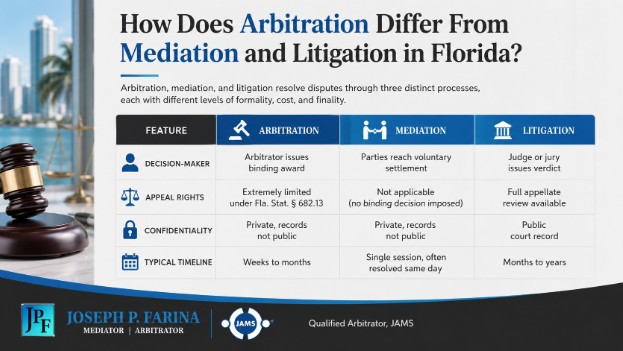
Arbitration, mediation, and litigation resolve disputes through three distinct processes, each with different levels of formality, cost, and finality.
| Feature | Arbitration | Mediation | Litigation |
| Decision-maker | Arbitrator issues binding award | Parties reach voluntary settlement | Judge or jury issues verdict |
| Appeal rights | Extremely limited under Fla. Stat. § 682.13 | Not applicable (no binding decision imposed) | Full appellate review available |
| Confidentiality | Proceedings are private; whether case details stay confidential depends on the agreement | Private, records not public | Public court record |
| Typical timeline | Weeks to months, varying with case complexity and scheduling | Single session, often resolved same day | Months to years |
Parties who cannot reach a settlement through mediation may pursue arbitration when their contract designates it as the applicable dispute-resolution method — arbitration and litigation are separate paths, not a required next step after mediation.
Arbitration awards carry the same enforceability as a court judgment once confirmed. Florida’s Revised Arbitration Code, Chapter 682 of the Florida Statutes, makes a written agreement to arbitrate valid, enforceable, and irrevocable except on the same grounds available to revoke any contract.
Once an arbitrator issues an award, either party may petition the court to confirm it under Section 682.12, converting the award into an enforceable judgment.
A court will only vacate an award, as defined under Section 682.13, on narrow statutory grounds.
Florida’s narrow vacatur standard gives arbitration awards their practical finality compared to litigated verdicts.
Florida businesses and property owners commonly bring five categories of disputes to arbitration in Miami-Dade County — contract, construction, employment, real estate, and HOA disputes — when an underlying contract, lease, or governing document requires arbitration as the resolution method.
Not every dispute in these categories is subject to arbitration; eligibility depends on the specific agreement and applicable law.
Disputes involving tenant claims and prior property damage also proceed to arbitration when the underlying lease or sale contract contains a binding arbitration clause.
Parties should weigh several factors before designating arbitration as the method of resolution.
Florida’s narrow vacatur standard under Section 682.13 confines a court’s review to grounds such as fraud or corruption in procuring the award, arbitrator partiality, procedural inequities, an arbitrator exceeding designated powers, absence of an agreement to arbitrate, or improper notice, so an arbitrator’s factual or legal error is rarely grounds to overturn an award, and parties forgo the extensive appellate review available in litigation.
Smaller-value disputes can be disproportionately affected by JAMS’s filing fee, case management fee, and the arbitrator’s hourly rate, since these costs do not scale down with the amount in controversy.
Disputes requiring extensive document discovery or third-party subpoenas may find arbitration’s more limited discovery tools less suited to the case than a court’s discovery process.
Arbitration is available only where a valid, enforceable arbitration clause exists or where all parties agree to arbitrate after a dispute has arisen.
Property owners and employers reviewing a contract, HOA, or employment dispute can confirm with JAMS Miami whether their agreement designates binding arbitration.
Arbitration costs at JAMS in 2026 combine a fixed filing fee, a percentage-based case management fee, and the arbitrator’s individually set hourly rate.
| Fee Component | Amount |
| Filing fee — two-party matter | $2,000 |
| Filing fee — three or more parties | $3,500 |
| Case Management Fee | 13% of all professional fees billed |
| Consumer arbitration (JAMS Consumer Minimum Standards) | Capped at $250 for the consumer |
| Employment arbitration (JAMS Employment Minimum Standards) | Capped at $400 for the employee |
| Arbitrator professional/hourly fee | Set individually by the arbitrator |
The JAMS fee figures above come from JAMS’s published Fee Schedule. Under JAMS’s Comprehensive Arbitration Rules, Rule 31(a), each party generally pays a pro rata share of these fees and expenses unless the parties agree to a different allocation.
This general pro rata default does not apply to matters governed by JAMS’s Consumer or Employment Minimum Standards, which cap the consumer’s or employee’s share as shown above regardless of Rule 31’s default allocation.
Because the arbitrator’s hourly rate varies by case complexity, parties should confirm current rates directly with a JAMS case manager before filing.
Judge Farina opens the hearing, hears opening statements from each party’s counsel, and then receives evidence and witness testimony under relaxed evidentiary standards compared to civil court.
Many single-issue contract and business disputes are resolved within a single hearing day, while multi-party or document-heavy commercial matters may require two or more hearing days at JAMS’s Miami facility.
Following the hearing, the arbitrator issues a written award within the time specified in the arbitration agreement or, absent such a deadline, within the time set by the arbitrator.
Parties initiate arbitration by giving written notice of the dispute to the opposing party in the manner specified in their arbitration agreement, describing the nature of the controversy and the remedy sought.
If the parties’ contract already names Judge Farina or JAMS as the arbitration forum, the filing proceeds directly to JAMS’s Miami office for case assignment.
Where no arbitration clause exists, but both parties are willing to arbitrate, they may sign a new agreement designating Judge Farina before the dispute proceeds. Business owners and their counsel can contact JAMS Miami to confirm scheduling and case requirements before filing.
Disputes that stall in negotiations and are not resolved through direct settlement discussions may proceed to arbitration once counsel confirms that arbitration is available under the governing contract.
Reviewing the underlying contract for an arbitration clause is typically the first step before filing suit, since the clause determines whether arbitration is available and where to file.
Is an arbitration award the same as a court judgment? An arbitration award is not automatically a court judgment. A party must petition the court to confirm the award under Florida Statutes Section 682.12. Once confirmed, the award becomes enforceable as a judgment, allowing collection through the same mechanisms available for any civil judgment.
Can an arbitration award be appealed in Florida? Arbitration awards face extremely limited appellate review compared to litigated verdicts. Florida courts vacate an award only on the narrow statutory grounds set out in Section 682.13 of the Revised Florida Arbitration Code: the award was procured by fraud or corruption, the arbitrator was not impartial, procedural inequities occurred, the arbitrator exceeded designated powers or jurisdiction, the parties did not agree to arbitration, or arbitration was initiated without proper notice.
Does a contract need an arbitration clause before a dispute can go to arbitration? Most arbitrations proceed under a pre-existing arbitration clause in the parties’ contract. Parties without such a clause can still arbitrate if they sign a new agreement after the dispute arises, designating an arbitrator and the arbitration rules that will govern the proceeding.
How long does an arbitration hearing take? Many single-issue business and contract disputes resolve in a single hearing day. Complex commercial matters involving multiple parties, extensive documents, or witness testimony may require two or more hearing days, scheduled according to case complexity, party availability, and the arbitrator’s calendar.
Who pays the arbitrator’s fees in a JAMS arbitration? Each party typically pays a pro rata share of JAMS’s filing fee, case management fee, and the arbitrator’s professional fees under JAMS Rule 31, unless the parties’ agreement specifies a different allocation. Consumer and employment arbitrations follow separate, capped fee minimums that override this general pro rata default.
Is arbitration confidential in Florida? Arbitration proceedings and JAMS case files are private, unlike court litigation, which creates a public record. Confidentiality of specific case details is not automatic — it depends on the parties’ arbitration agreement and applicable JAMS rules — and a court proceeding to confirm or vacate an award under Chapter 682 can become part of the public record.
What disputes cannot be resolved through arbitration in Florida? Florida’s Revised Arbitration Code, codified in Chapter 682 of the Florida Statutes, excludes disputes involving child custody, visitation, or child support from its coverage under Section 682.25. Commercial, contract, construction, employment, and real estate disputes are commonly eligible for arbitration when the parties have a valid arbitration agreement, though eligibility for a specific claim depends on the governing contract and applicable law.
What is the difference between binding and non-binding arbitration? Binding arbitration produces a final, enforceable award that the parties must comply with, subject to the narrow grounds for vacatur under Section 682.13. Non-binding arbitration is ordered by a judge before either a bench or jury trial and is governed by Florida Statute 44.103 and Florida Rules of Civil Procedure 1.820. If a party disagrees with the arbitrator’s decision, a judge or jury trial may follow; however, there may be financial penalties if the disagreeing party’s judgment is less successful than the arbitrator’s award.
Can an attorney represent a party during arbitration? Parties have the right to attorney representation at any arbitration proceeding under Florida Statutes Section 682.07. The right to attorney representation applies regardless of what the arbitration agreement states, except in limited labor arbitration contexts where an employer and union may waive it by agreement.
How does a party choose an arbitrator in Miami? Parties typically name an arbitrator directly in their contract’s arbitration clause or select one through an arbitration organization’s roster, such as JAMS. If the agreed method fails or the parties cannot agree, a Florida court may appoint an arbitrator under Section 682.04.
Parties in a stalled contract dispute can schedule an arbitration consultation with Judge Farina through JAMS Miami to discuss whether binding arbitration fits their timeline and budget.

