
Free Consultation
Free Consultation
Employment arbitration is a private dispute resolution process that settles workplace disputes through a binding decision by a neutral arbitrator rather than a courtroom trial.
Florida employers and employees use employment arbitration services when an employment agreement requires it.
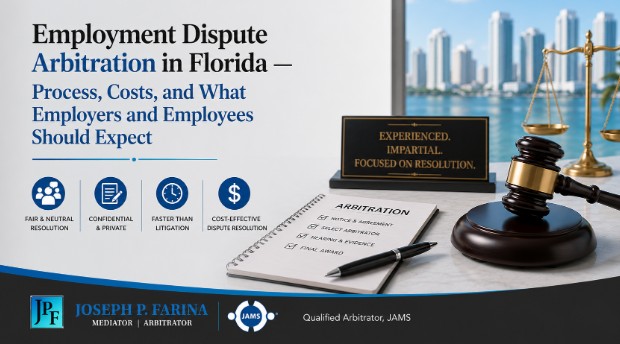
Federal law carves out certain claims, most notably sexual harassment and assault, that cannot be forced into arbitration regardless of what the agreement says.
Employers and employees with a workplace dispute headed toward arbitration can request an employment arbitration consultation to confirm which claims their agreement actually covers.
Employment arbitration proceeds when an employer and employee present evidence to a neutral arbitrator, who issues a binding decision in place of a jury or judge.
Florida courts enforce employment arbitration clauses when the employee received adequate notice of the clause, the clause is supported by consideration such as continued employment, and the terms are not unconscionable.
Florida employers and employees also have access to employment dispute mediation as a non-binding alternative before arbitration or litigation becomes necessary.
An arbitrator with judicial experience, such as retired Chief Judge Joseph P. Farina, Florida Supreme Court Qualified Arbitrator at JAMS, applies the same evidentiary rigor as a courtroom while keeping the dispute out of the public record.
Florida employers and employees route four categories of workplace disputes to arbitration when their employment agreement requires it.
| Dispute Type | Common Trigger |
| Wrongful termination | Termination allegedly in violation of contract terms or statutory protections |
| Unpaid wages | Disputes over unpaid overtime, minimum wage, or final paycheck amounts |
| Breach of employment contract | Failure to honor compensation, benefits, or severance terms |
| Non-compete enforcement | Alleged violation of a restrictive covenant after employment ends |
Breach of employment contract claims often overlap with broader commercial contract disputes when the employment agreement includes equity, bonus, or partnership-track terms, so the same arbitration clause can govern both the employment relationship and a related business dispute.
Sexual harassment and sexual assault claims cannot be forced into pre-dispute arbitration under federal law, even when the employee signed a valid arbitration agreement.
The Ending Forced Arbitration of Sexual Assault and Sexual Harassment Act, a 2022 federal law codified at 9 U.S.C. §§ 401-402, gives the person alleging the conduct the election to bring the claim in court instead, regardless of what the employment agreement says.
This carve-out applies only to claims arising on or after March 3, 2022, so conduct alleged to have occurred before that date does not fall under the Act’s protection.
An employee electing to void the arbitration agreement under this Act may also pursue the claim as a class or collective action even if the original agreement waived that right, so an arbitration clause cannot be used to keep these specific claims out of court or to prevent them from proceeding collectively.
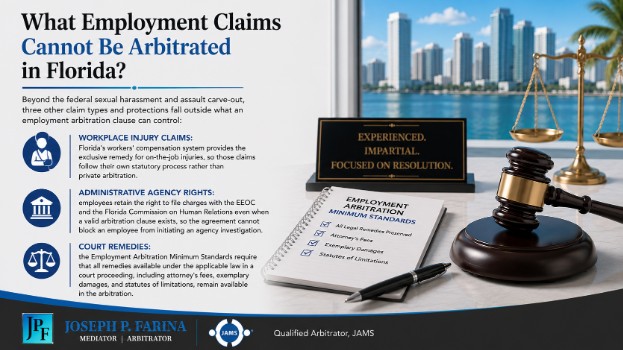
Beyond the federal sexual harassment and assault carve-out, three other claim types and protections fall outside what an employment arbitration clause can control:
An employer cannot use an arbitration clause to quietly strip an employee of remedies they would otherwise have in court, since compliance with these standards is a condition of administration.
A non-compete dispute can proceed through arbitration when the employment agreement’s arbitration clause covers restrictive covenant claims, running alongside rather than replacing Florida’s non-compete law, which governs whether the underlying restriction is enforceable in the first place.
An arbitrator applies the same reasonableness standard a Florida court would: the restriction must be supported by a legitimate business interest and reasonable in time, area, and line of business.
Florida also recently expanded enforcement of non-compete agreements for certain covered agreements. So an employer relying on a non-compete agreement should confirm the current enforcement window that applies to it rather than assume the traditional standard automatically controls.
Employment arbitration costs in 2026 fall disproportionately on the employer under JAMS’s fee structure, so employees are not priced out of pursuing valid claims.
| Fee Component | Amount |
| Employee’s maximum cost | $400, under JAMS Employment Arbitration Minimum Standards |
| Remaining filing and administrative fees | Paid by the employer |
| Case Management Fee | 13% of professional fees billed |
| Arbitrator professional/hourly fee | Set individually by the arbitrator, employer-paid share |
The fee figures above come from JAMS’s Employment Minimum Standards and Fee Schedule.
JAMS will accept a mandatory employment arbitration assignment only if the underlying clause complies with these minimum standards, and will decline to administer any agreement that shifts high costs onto the employee.
An employment arbitration award carries the same enforceability as a court judgment once confirmed. Florida’s Revised Arbitration Code, Section 682.02 of the Florida Statutes, makes a written agreement to arbitrate valid, enforceable, and irrevocable, so an employer or employee cannot back out of a properly formed arbitration clause once a dispute arises.
Either party may petition the court to confirm the award under Section 682.12, converting it into an enforceable judgment.
Courts vacate awards only on narrow grounds, such as evident partiality or arbitrator misconduct, under Section 682.13, so a losing party cannot simply relitigate the same facts in court after an unfavorable award.
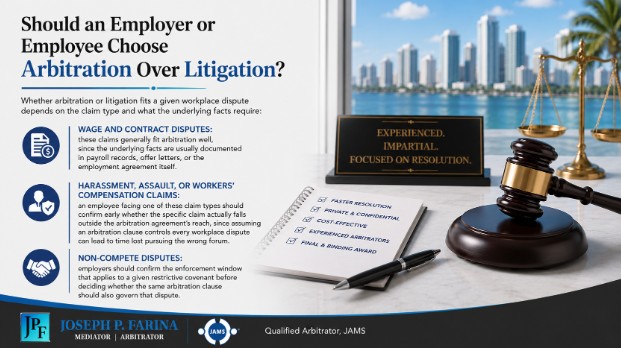
Whether arbitration or litigation fits a given workplace dispute depends on the claim type and what the underlying facts require:
Employers and employees with a workplace dispute can request an employment arbitration consultation to confirm which claims their agreement actually covers before proceeding.
Can an employer force an employee to arbitrate a wrongful termination claim? An employer can require arbitration of a wrongful termination claim if the employee signed a valid arbitration agreement supported by consideration, such as continued employment. Florida courts enforce these clauses unless the employee lacked adequate notice or the terms are unconscionable.
Are unpaid wage claims arbitrable in Florida? Unpaid wage and overtime claims are generally arbitrable when covered by a valid employment arbitration agreement. The Employment Minimum Standards require that all remedies available in court, including attorney’s fees, exemplary damages, and statutes of limitations, remain available in the arbitration.
Can a non-compete dispute be arbitrated instead of litigated? A non-compete dispute can be arbitrated when the employment agreement’s arbitration clause covers restrictive covenant claims. The arbitrator applies the same legitimate-business-interest and reasonableness standard a Florida court would when reviewing the underlying restriction’s enforceability, so the same requirements apply in either forum.
Does an arbitration agreement stop an employee from filing an EEOC complaint? An arbitration agreement does not stop an employee from filing an administrative charge with the EEOC or the Florida Commission on Human Relations. Employees retain this right regardless of what the arbitration agreement says about litigation in court, since these are separate administrative rights.
Can a company force sexual harassment claims into arbitration? A company cannot force sexual harassment or sexual assault claims into arbitration under the Ending Forced Arbitration Act, a 2022 federal law. The employee alleging the conduct may bring the claim in court instead, even if a signed arbitration agreement exists.
Do workplace injury claims go through employment arbitration? Workplace injury claims do not go through employment arbitration in Florida. The workers’ compensation system provides the exclusive remedy for on-the-job injuries, keeping those claims in a separate statutory process regardless of an existing arbitration agreement, since this exclusivity applies independently of any employment contract.
How much does an employee pay for JAMS employment arbitration? An employee pays no more than $400 total under the Employment Arbitration Minimum Standards. The employer covers the remaining filing fees and the bulk of the arbitrator’s professional fees, including the 13% case management fee assessed on all billed professional fees.
Can an employment arbitration award be appealed? Employment arbitration awards face extremely limited appellate review compared to litigated verdicts. Florida courts vacate awards only on narrow statutory grounds, including arbitrator corruption, evident partiality, or misconduct, under Section 682.13 of the Revised Florida Arbitration Code, so the losing party cannot relitigate in court.
What happens if an arbitration clause tries to limit an employee’s legal remedies? An arbitration clause that limits remedies an employee would otherwise have in court violates the Employment Minimum Standards. The administration of mandatory employment arbitration requires that all court remedies, including attorneys’ fees and statutes of limitations, remain available to the employee.
Employers and employees facing a wrongful termination, wage, or non-compete dispute can request an employment arbitration consultation rather than assume litigation is the only path forward.

