
Free Consultation
Free Consultation
Real estate arbitration in Miami resolves foreclosure, title, and property disputes through a binding or non-binding decision from a neutral arbitrator instead of a negotiated settlement.
Those proceedings are governed by Florida’s Arbitration Code, Chapter 682, Florida Statutes, and are conducted through Miami Civil Mediator, a real estate arbitration and mediation practice based in Miami, Florida.
Arbitration fits a Miami property dispute when the purchase contract contains an arbitration clause, mediation has stalled, or a foreclosure defendant wants to avoid a lengthy circuit court calendar.
Joseph P. Farina, a Florida Supreme Court Qualified Arbitrator based in Miami, handles these matters.
Property owners facing a stalled Miami foreclosure or unresolved title dispute can schedule real estate arbitration with Joseph P. Farina by contacting Miami Civil Mediator.
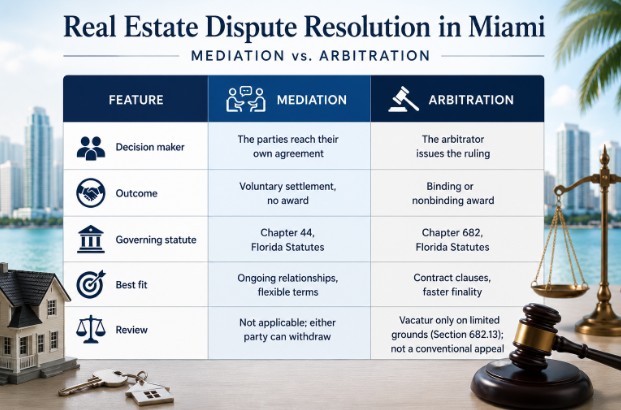
Real estate arbitration is a private dispute-resolution process in which a neutral arbitrator hears evidence from both sides and issues a ruling, functioning much like a judge’s decision in court. Understanding how arbitration and mediation differ in Florida helps parties decide which process suits a property dispute.
Miami property owners, buyers, sellers, and lenders turn to arbitration when they need a definitive outcome rather than a negotiated compromise.
| Feature | Mediation | Arbitration |
| Decision maker | The parties reach their own agreement | The arbitrator issues the ruling |
| Outcome | Voluntary settlement, no award | Binding or non-binding award |
| Governing statute | Chapter 44, Florida Statutes | Chapter 682, Florida Statutes |
| Best fit | Ongoing relationships, flexible terms | Contract clauses, faster finality |
| Review | Not applicable; either party can withdraw | Vacatur only on limited grounds (Section 682.13); not a conventional appeal |
A real estate dispute that involves an ongoing landlord-tenant relationship or a neighbor boundary disagreement usually favors mediation.
A dispute governed by a signed arbitration clause, or one where a final ruling matters more than preserving the relationship, moves to arbitration instead.
Whether a Miami-Dade foreclosure dispute can go to arbitration depends on the specific mortgage or note language, the parties’ agreement, and the case’s procedural posture — foreclosure itself does not automatically trigger arbitration.
Chapter 702, Florida Statutes, governs the foreclosure of mortgages and statutory liens filed in Miami-Dade Circuit Court, and arbitration operates alongside that process only when a contractual or voluntary basis exists.
Depending on the governing contract and the issue in dispute, arbitration may become relevant to:
Each of these requires its own review of the underlying contract or statutory basis before arbitration applies.
Property owners can verify a pending foreclosure filing, lis pendens, or sale date through the Miami-Dade Clerk of Courts Mortgage Foreclosures records.
Whether a short sale, condominium, or title dispute in Miami-Dade County is suited to arbitration depends on the specific purchase contract, lender agreement, or association governing documents involved — arbitrability is never automatic based on dispute type alone.
Joseph P. Farina, a retired Chief Judge of Florida’s Eleventh Judicial Circuit and Florida Supreme Court Qualified Arbitrator, conducts real estate and foreclosure arbitration hearings in Miami following a structured, predictable sequence.
Miami-Dade property owners working through an HOA dispute or a related contract dispute can request Farina as arbitrator once both sides agree to the process.
Condo owners and lenders untangling a Miami-Dade property dispute can move the case to binding arbitration by scheduling a consultation with Miami Civil Mediator.
Florida law recognizes three distinct arbitration tracks, and the applicable track depends on how the dispute reaches arbitration in the first place. Each of the binding and non-binding arbitration tracks carries its own rules for finality and review.
| Type | Governing Law | How It’s Triggered | Result |
| Voluntary binding arbitration | Section 44.104, Florida Statutes | Parties agree by contract or after the dispute arises | Final award, limited review rights |
| Court-ordered non-binding arbitration | Section 44.103, Florida Statutes | A Miami-Dade Circuit Court judge refers a contested civil action | Either party may request a trial de novo |
| Contractual arbitration | Chapter 682, Florida Statutes (Arbitration Code) | An arbitration clause in the deed, mortgage, or purchase contract | Binding award confirmed by the circuit court |
A real estate purchase contract with a written arbitration clause typically falls under the Chapter 682 framework, which makes the resulting award binding and enforceable in Miami-Dade Circuit Court once confirmed.
The exact track that applies depends on the specific contract language and procedural posture of the case, and this table should be treated as a general orientation rather than a substitute for reviewing the governing document itself.
Real estate arbitration timelines vary based on the complexity of the dispute, the terms of the arbitration agreement, and arbitrator availability.
The process is generally structured to avoid the extended discovery and court calendar delays that can affect a contested foreclosure or title lawsuit filed in Miami-Dade Circuit Court. However, no fixed timeframe applies to every case.
The arbitrator’s fee is set by agreement between the parties or by the arbitration organization named in the contract, rather than by court filing fees.
Property owners comparing the two paths should weigh arbitration’s structural advantages — a private hearing and limited grounds to vacate the award — against the broader discovery and appellate rights preserved in traditional real estate dispute resolution litigation.
What is the difference between mediation and arbitration for a Miami real estate dispute?
Mediation helps the parties negotiate their own voluntary settlement, with no ruling issued if they cannot agree. Arbitration ends with a binding or non-binding decision from a neutral arbitrator after both sides present evidence, similar to a private trial without a jury.
Is real estate arbitration binding in Florida?
Arbitration is binding when the parties agree to it by contract or afterward, under Chapter 682, Florida Statutes. Court-ordered non-binding arbitration under Section 44.103 allows either party to request a trial de novo if dissatisfied with the arbitrator’s decision.
Can a foreclosure case be arbitrated in Miami-Dade County?
A Miami-Dade foreclosure case may move to arbitration when the mortgage or note contains an arbitration clause, or when both parties voluntarily agree to arbitrate a contested issue such as a deficiency judgment or a disputed loan modification. Whether it applies depends on the specific documents involved.
What real estate contracts include an arbitration clause?
Purchase and sale agreements, commercial leases, condominium association bylaws, and some mortgage documents commonly include an arbitration clause. The clause typically names the governing rules, the arbitrator selection method, and whether the resulting award is binding.
How long does real estate arbitration take in Miami?
Real estate arbitration timelines in Miami vary with dispute complexity, the arbitration agreement, and arbitrator availability. The process is generally structured to avoid the extended discovery and court calendar delays common in contested circuit court litigation, though no fixed timeframe applies to every case.
Can a condo association dispute go to arbitration in South Florida?
Condo arbitration in South Florida may resolve disputes over special assessments, board decisions, and unpaid fees between a unit owner and the association, but only where the association’s governing documents require or permit arbitration.
What happens at a real estate arbitration hearing?
Each party presents evidence and calls witnesses before the arbitrator, who may also permit depositions and limited discovery under Section 682.08. The arbitrator then issues a written award within the time set by the arbitration agreement or the court.
Can a title defect dispute be arbitrated in Miami-Dade County?
A title defect dispute can be arbitrated in Miami-Dade County when the parties have a written agreement to arbitrate, either a clause in the purchase contract or a submission agreement signed after the dispute arises, under Section 682.02, Florida Statutes. Without that agreement, the dispute proceeds in circuit court unless a judge refers it to arbitration under Section 44.103.
Does a short sale dispute qualify for arbitration in Miami-Dade?
A short sale dispute qualifies for arbitration in Miami-Dade when the purchase contract or lender agreement contains an arbitration clause covering deficiency waivers or closing terms. Without that clause, the parties typically need to agree to arbitrate voluntarily.
Who selects the arbitrator for a Miami real estate dispute?
The parties select the arbitrator by the method stated in their arbitration agreement. If that method fails or the parties never agreed on one, Section 682.04 allows either party to ask the circuit court to appoint an arbitrator.
Real estate arbitration in Miami delivers a binding or non-binding ruling from a neutral arbitrator through a process generally structured to avoid the extended court calendar delays of contested litigation, though actual timing depends on the dispute’s complexity and the arbitration agreement.
Chapter 682, Florida Statutes, governs contractual arbitration, while Sections 44.103 and 44.104 cover court-ordered and voluntary binding tracks.
Whether a foreclosure, short sale, condo, or title dispute in Miami-Dade County can move to arbitration depends on the specific contract clause, governing document, or statute involved.
A stalled Miami property dispute rarely resolves on its own. Property owners, lenders, and associations can contact Miami Civil Mediator to discuss whether arbitration fits their case.

