
Free Consultation
Free Consultation

Arbitration and mediation are Florida’s two primary forms of alternative dispute resolution, and the difference comes down to who makes the final decision.
Mediation helps the parties negotiate a voluntary settlement, while arbitration gives a neutral arbitrator the decision-making role and issues a binding or non-binding ruling.
Miami Civil Mediator, a mediation and arbitration practice based in Miami, Florida, guides parties through both processes, which operate under different provisions of Florida Statutes Chapter 44 and Chapter 682 depending on how the process arises.
Parties unsure which process fits their dispute can discuss both options with Joseph P. Farina before deciding how to proceed.
Mediation is a voluntary, non-adversarial process in which a neutral mediator helps the parties negotiate their own settlement, with no ruling issued unless both sides agree.
Arbitration is a private, trial-like process in which a neutral arbitrator hears evidence from both sides and issues a decision, similar to a judge’s ruling in court.
| Feature | Mediation | Arbitration |
| Decision maker | The parties reach their own agreement | The arbitrator issues the ruling |
| Outcome | Voluntary settlement, enforceable once signed | Binding or non-binding award |
| Primary governing statute | Chapter 44, Florida Statutes | Chapter 682, Florida Statutes |
| Formality | Informal, private sessions with the mediator | Structured hearing with evidence and witnesses |
| Cost driver | Mediator’s fee, typically shared by the parties | Arbitrator’s fee, set by agreement or arbitration organization |
| Relationship impact | Generally preserves the relationship through negotiated compromise | May affect the relationship, since one party’s position prevails |
The difference between arbitration and mediation becomes clearest in outcome: mediation ends in a settlement the parties chose, while arbitration ends in a decision imposed on them by a neutral third party.
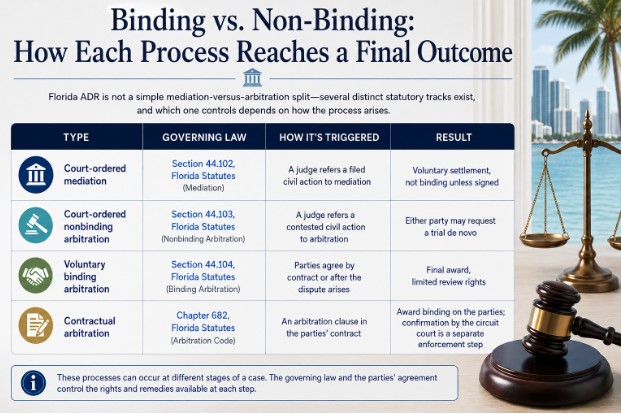
Florida ADR is not a simple mediation-versus-arbitration split — several distinct statutory tracks exist, and which one controls depends on how the process arises. Arbitration alone runs on three statutory arbitration tracks, each with a different approach to finality.
| Type | Governing Law | How It’s Triggered | Result |
| Court-ordered mediation | Section 44.102, Florida Statutes | A judge refers a filed civil action to mediation | Voluntary settlement, not binding unless signed |
| Court-ordered non-binding arbitration | Section 44.103, Florida Statutes | A judge refers a contested civil action to arbitration | Either party may request a trial de novo |
| Voluntary binding arbitration | Section 44.104, Florida Statutes | Parties agree by contract or after the dispute arises | Final award, limited review rights |
| Contractual arbitration | Chapter 682, Florida Statutes (Arbitration Code) | An arbitration clause in the parties’ contract | Award binding on the parties; confirmation by the circuit court is a separate enforcement step |
The track that applies to a specific dispute depends on the contract language, whether a court has already referred the case, and whether the parties agree to binding or non-binding terms.
The choice between mediation and arbitration typically comes down to a handful of practical factors, not a single rule of thumb. The question of when arbitration fits better than mediation usually starts with the governing contract.
Some Florida contracts name a private ADR provider, such as the American Arbitration Association or JAMS, to administer the arbitration and supply procedural rules; when a contract does so, its selected provider’s rules govern alongside Chapter 682.
Parties uncertain which process fits their situation can schedule a consultation with Miami Civil Mediator to review the contract and dispute specifics before committing to either process.
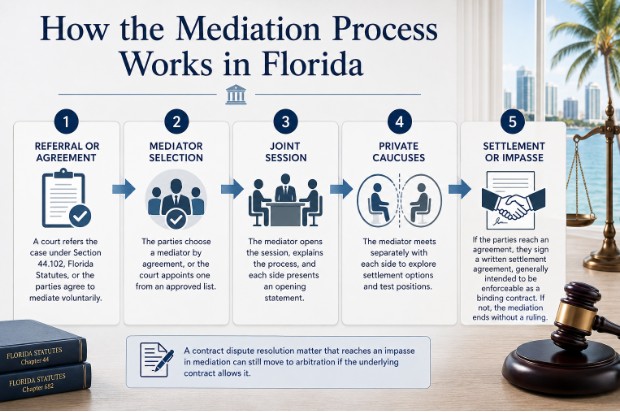
Florida mediation follows a structured sequence set out under Chapter 44, Florida Statutes, and the rules adopted by the Florida Supreme Court.
A contract dispute resolution matter that reaches an impasse in mediation can still move to arbitration if the underlying contract allows it.
Arbitration under Chapter 682, Florida Statutes, follows a more structured, trial-like sequence than mediation.
An HOA dispute or a real estate matter with an arbitration clause typically follows this same sequence once both sides agree to proceed.
Florida parties are not limited to a strict choice between mediation and arbitration; several hybrid and court-connected options exist.
Property owners and businesses can review the Florida Courts’ official mediation and arbitration program pages for additional detail on court-connected ADR options.
Businesses and individuals weighing a construction dispute or a real property matter can move forward with confidence once they know which track — mediation, arbitration, or med-arb — fits their case.
Miami Civil Mediator helps Miami-Dade parties make that determination before a dispute drags on.
What is the main difference between arbitration and mediation?
In mediation, the parties negotiate their own voluntary settlement, and no ruling is issued unless both sides agree. Arbitration ends with a binding or non-binding decision from a neutral arbitrator after both sides present evidence, similar to a private trial.
Should I choose mediation or arbitration for my dispute?
The right choice depends on the contract governing the dispute, whether the parties want to preserve their relationship, and how much control each side wants over the outcome. A contract with an arbitration clause often answers that question directly.
What does binding vs. non-binding mean in Florida ADR?
A binding decision is final and enforceable in court, with review limited to narrow grounds such as arbitrator misconduct. A non-binding decision, such as court-ordered arbitration under Section 44.103, allows either party to request a trial de novo.
Is mediation or arbitration better for a business dispute?
Neither process is universally better; mediation typically preserves the business relationship through a negotiated settlement, while arbitration provides a faster, binding resolution when the relationship is already strained, or a contract requires it.
What ADR options are available in Florida besides mediation and arbitration?
Florida also recognizes med-arb, a hybrid process combining both methods, along with standing neutral arrangements and court-ordered referrals to mediation or non-binding arbitration under Chapter 44, Florida Statutes.
Can a contract require arbitration instead of mediation?
A contract can require arbitration through a written arbitration clause, which typically falls under Chapter 682, Florida Statutes, unless both parties agree to mediate the dispute instead or the contract requires mediation first.
How long does mediation take compared to arbitration in Florida?
Both mediation and arbitration are typically faster than litigation, though the exact timeline depends on the dispute’s complexity, the mediator or arbitrator’s availability, and whether the parties reach an agreement or a hearing is required.
What happens if mediation fails in Florida?
If mediation ends in an impasse, the parties may proceed to arbitration if their contract requires it, pursue litigation, or agree to try mediation again with a different mediator or additional information.
Can an arbitration award be appealed in Florida?
Florida law does not provide a conventional merits appeal of an arbitration award. Section 682.13 allows a court to vacate the award only on narrow grounds, such as arbitrator misconduct or exceeding authority — not disagreement with the outcome.
What is med-arb and how does it work?
Med-arb combines mediation and arbitration into a single process: the parties first attempt to negotiate a settlement through mediation, and if they cannot agree, the same or a different neutral resolves the remaining issues through binding arbitration.
Arbitration and mediation both offer Florida parties an alternative to litigation, but they differ in who controls the outcome.
Mediation gives the parties the final say through a negotiated settlement; arbitration gives that authority to a neutral arbitrator whose ruling is binding or non-binding depending on the specific statutory track — Section 44.102, 44.103, 44.104, or Chapter 682 — that governs how the process arose.
The right process depends on the governing contract, the parties’ relationship, and how much finality each side needs.
A dispute rarely resolves itself. Parties weighing mediation against arbitration can contact Miami Civil Mediator to determine which process fits their case.

