
Free Consultation
Free Consultation
Florida recognizes three distinct arbitration tracks, and whether an outcome is binding or non-binding depends on which one applies to the dispute — not on the word “arbitration” alone.
Contractual arbitration under Chapter 682, Florida Statutes, produces a binding award. Court-ordered arbitration under Section 44.103 is non-binding by default.
Voluntary binding arbitration under Section 44.104 sits between the two and has its own limited appeal mechanism.
If parties are unsure which track applies to their dispute, they can review their contract or court order with Joseph P. Farina before assuming an outcome is final.
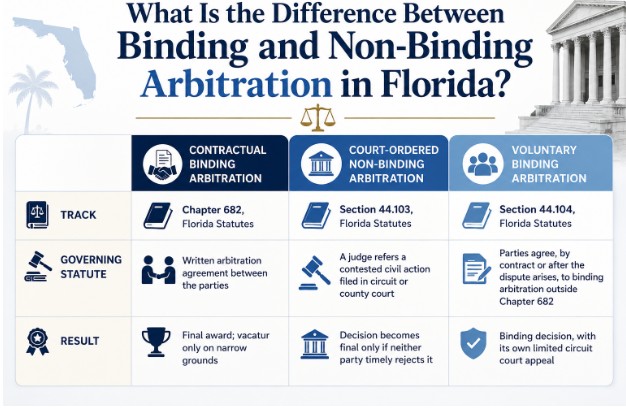
The difference comes down to whether either party can reject the arbitrator’s decision and still take the dispute to trial.
| Track | Governing Statute | How It Arises | Result |
| Contractual binding arbitration | Chapter 682, Florida Statutes | Written arbitration agreement between the parties | Final award; vacatur only on narrow grounds |
| Court-ordered non-binding arbitration | Section 44.103, Florida Statutes | A judge refers a contested civil action filed in circuit or county court | Decision becomes final only if neither party timely rejects it |
| Voluntary binding arbitration | Section 44.104, Florida Statutes | Parties agree, by contract or after the dispute arises, to binding arbitration outside Chapter 682 | Binding decision, with its own limited circuit court appeal |
Florida law creates these tracks deliberately: Chapter 682 serves parties who want a definitive private resolution through their own agreement, Section 44.103 gives the court system a screening tool for contested civil actions before trial, and Section 44.104 lets parties opt into a binding outcome even in a case that would otherwise proceed under a different track.
Binding arbitration in Florida is governed primarily by Chapter 682, Florida Statutes, known as the Florida Arbitration Code.
A written arbitration agreement — whether in a purchase contract, commercial lease, or construction agreement — is valid, enforceable, and irrevocable under Section 682.02.
The agreement itself is what makes the arbitrator’s award binding on the parties; court confirmation under Section 682.12 is a separate step that converts the already-binding award into an enforceable court judgment. This is the track most Florida businesses encounter through an arbitration clause in a signed contract.
Section 44.104 provides a second, separate path to a binding outcome, available when the parties agree to it directly rather than through a Chapter 682 arbitration clause.
Arbitration is non-binding in Florida when a judge refers a contested civil action filed in circuit or county court to arbitration under Section 44.103, Florida Statutes, rather than the parties choosing arbitration through their own contract. That distinction often drives the decision when parties are choosing arbitration over mediation in the first place.
This court-connected process differs from contractual arbitration in several ways.
Florida also recognizes voluntary binding arbitration under Section 44.104, Florida Statutes, which lets parties agree — either in a contract or after a dispute arises — to a binding outcome rather than proceeding under the default non-binding track.
Whether an arbitration outcome can be appealed depends on which of the three tracks applies — there is no single answer for “arbitration” in Florida.
| Track | Review Path | Available Grounds |
| Chapter 682 binding award | No merits appeal; vacatur only, under Section 682.13 | Corruption, fraud, evident arbitrator partiality or misconduct, exceeding authority, or improper notice — not disagreement with the outcome |
| Section 44.103 non-binding decision | Trial de novo, not an appeal | Timely notice of rejection and request for trial within 20 days under Fla. R. Civ. P. 1.820(h) |
| Section 44.104 voluntary binding arbitration | Limited appeal to circuit court | Grounds specified in Section 44.104, distinct from Chapter 682’s vacatur standard |
A party seeking to vacate a Chapter 682 binding award must file the motion within 90 days of receiving notice of the award.
Separately, Section 682.20 allows an appeal of certain court orders arising from Chapter 682 arbitration — such as an order confirming, vacating, or modifying an award, or an order compelling or staying arbitration — the same way any other civil order can be appealed.
That is different from appealing the arbitrator’s decision itself, which Chapter 682 does not permit on the merits.
A Chapter 682 binding award becomes enforceable once a Florida court confirms it under Section 682.12, at which point it carries the same force as a court judgment.
Either party may move the court for an order confirming the award after receiving notice of it, and the court issues that order unless the award has been modified, corrected, or vacated under the statute’s other provisions.
Once confirmed, the award can be recorded and enforced like any other civil judgment.
A Section 44.103 non-binding decision carries no independent enforceability of its own — it becomes enforceable only if neither party files a timely notice of rejection. At this point, Fla. R. Civ. P. 1.820(h) directs the decision to the presiding judge for entry of the orders and judgments needed to carry it out.
Businesses working through a construction dispute with an arbitration clause can confirm which enforcement path applies before assuming an award is automatically collectible.
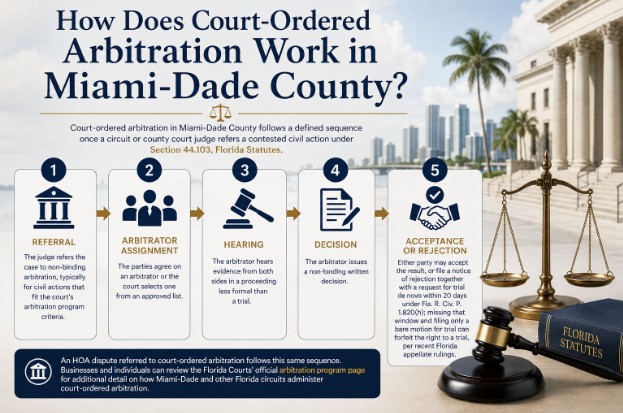
Court-ordered arbitration in Miami-Dade County follows a defined sequence once a circuit or county court judge refers a contested civil action under Section 44.103, Florida Statutes. The same Section 44.103 framework governs court-connected arbitration in Broward County through the Seventeenth Judicial Circuit.
An HOA dispute referred to court-ordered arbitration follows this same sequence. Businesses and individuals can review the Florida Courts’ official arbitration program page for additional detail on how Miami-Dade and other Florida circuits administer court-ordered arbitration.
Parties working through any of these tracks can schedule a consultation with Miami Civil Mediator to confirm which process applies to their case.
What is the main difference between binding and non-binding arbitration? Binding arbitration produces a final, enforceable award that neither party can simply reject. Non-binding arbitration produces a decision either party can reject within a strict deadline in favor of a trial de novo, making it closer to a court-supervised evaluation than a final ruling.
Can an arbitration decision be appealed in Florida? A Chapter 682 binding award cannot be appealed on the merits — Section 682.13 allows a court to vacate it only for narrow reasons like arbitrator misconduct. Section 44.104 voluntary binding arbitration has its own separate, limited appeal to circuit court.
Is a binding arbitration award enforceable in Florida? Yes. Once a court confirms a Chapter 682 award under Section 682.12, it carries the same enforceability as a civil judgment, including the ability to pursue collection if the losing party does not comply.
What Florida statute governs arbitration? Chapter 682, Florida Statutes, governs contractual binding arbitration. Chapter 44 governs court-ordered non-binding arbitration under Section 44.103 and voluntary binding arbitration under Section 44.104.
How does court-ordered arbitration work in Miami-Dade County? A Miami-Dade circuit or county court judge refers a contested civil action to non-binding arbitration under Section 44.103. The arbitrator issues a decision, and either party may reject it and request a trial de novo within 20 days.
What happens if I disagree with a non-binding arbitration decision? A party who disagrees must file a notice of rejection together with a request for trial de novo within 20 days under Fla. R. Civ. P. 1.820(h). A bare motion for trial, without the notice of rejection, no longer preserves that right under the current rule.
Can arbitration be made binding even if a court ordered it? Yes. Section 44.104 allows parties to agree to voluntary binding arbitration, which can apply even in a case that started under a different track, if both sides consent and follow that statute’s procedure.
How long do I have to challenge a binding arbitration award? A motion to vacate a Chapter 682 binding award must generally be filed within 90 days after the party receives notice of the award, under Section 682.13.
Florida arbitration is not a single binding-or-non-binding choice. It runs on three separate statutory tracks, each with its own rules for finality and review.
A Chapter 682 award is binding and enforceable once confirmed, with vacatur limited to narrow grounds. A Section 44.103 court-ordered decision is non-binding unless neither side rejects it within 20 days. Section 44.104 voluntary binding arbitration sits between the two and has its own limited appeal.
Parties should confirm which track governs their dispute before assuming any particular outcome.
A dispute involving unclear arbitration terms rarely resolves itself. Parties can contact Miami Civil Mediator to determine which arbitration track applies to their case.

