
Free Consultation
Free Consultation
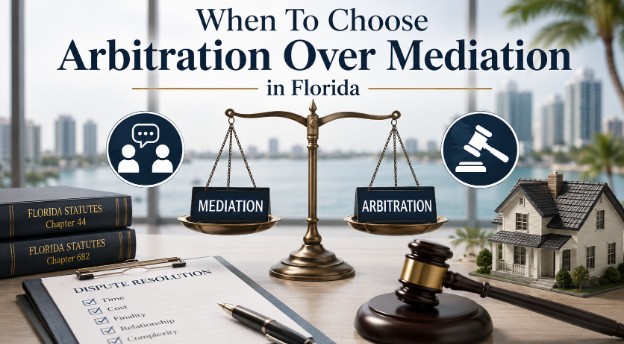
Private, contractual arbitration tends to outperform mediation when a binding, final decision matters more than a negotiated compromise.
Mediation only produces a settlement if both sides agree, while arbitration under Florida Statutes Chapter 682 ends in a binding ruling that either party must follow.
Arbitration is generally the stronger choice when a contract already requires it, when the parties prioritize finality over broader procedural rights, or when mediation has already reached an impasse.
Businesses facing a stalled negotiation or a contract-mandated dispute can discuss whether arbitration fits their case with Joseph P. Farina.
Arbitration makes more sense than mediation when a contract already requires it, when finality matters more than compromise, or when mediation has already failed. This article addresses private, contractual arbitration under Chapter 682, Florida Statutes — the form most Florida purchase agreements, commercial leases, and construction contracts invoke through an arbitration clause. The decision also turns on the difference between the two processes: one produces a decision, the other a negotiated agreement.
A contract that already contains an arbitration clause generally routes the dispute to arbitration regardless of either party’s later preference, since Section 682.02, Florida Statutes, makes a written arbitration agreement valid, enforceable, and irrevocable.
Beyond contractual requirements, arbitration becomes the stronger option when the dispute is too technical for informal negotiation or when one side has already tried mediation without success.
Arbitration’s core advantage is finality: it always produces a decision, while mediation can end without any resolution at all. That finality is protected by statute, since a Chapter 682 award can be set aside only on the narrow vacatur grounds under Section 682.13.
Because the arbitrator is required to rule on the dispute, the parties leave the process with a definite outcome rather than the open-ended uncertainty of a failed negotiation.
That ruling also carries a stronger sense of permanence than a mediated settlement, since a binding arbitration award can be vacated only on narrow grounds under Section 682.13, Florida Statutes — arbitrator misconduct or exceeding authority, not simple disagreement with the result.
Arbitration also tends to move faster than litigation, since it generally avoids the extended discovery and court calendar delays of a contested circuit court case, though the exact timeline still depends on the dispute’s complexity and the arbitration agreement itself.
The hearing is private, unlike a public court trial, though related filings — such as a motion to compel arbitration or to confirm or vacate the award — can still become part of the public record.
Parties can also select an arbitrator with direct experience in the dispute’s subject matter, which matters more in technical commercial or construction disputes than in a straightforward negotiation.
Several recurring Florida dispute types favor arbitration as the primary path rather than a fallback after mediation fails, most often where a contract requires it or the parties value finality over broader procedural rights.
Parties weighing whether their dispute fits this pattern can schedule a consultation with Miami Civil Mediator to review the contract and circumstances before committing to either process.
Arbitration cost depends on the arbitrator’s fee, any administering-organization charges, the number of hearing days, and how much discovery the dispute requires — it is not reliably cheaper or more expensive than litigation in every case.
Arbitration and mediation both involve paying the neutral directly, unlike litigation, where the primary cost to the court system is limited to filing fees.
Mediator and arbitrator fees are typically set by agreement between the parties, or by the rules of the arbitration organization named in the contract.
When a contract designates a private administering body, such as the American Arbitration Association or JAMS, that organization’s separate case-management and filing fees apply in addition to the arbitrator’s compensation, which mediation generally does not carry in the same form.
Section 682.08, Florida Statutes, gives the arbitrator discretion to limit discovery, which can reduce cost relative to the extensive document exchange and depositions common in circuit court litigation.
A straightforward, single-day arbitration with limited discovery typically costs less than a comparable litigated case; a complex, multi-day arbitration with several experts can approach or exceed that cost.
Parties comparing the two processes should weigh those specific cost drivers against the value of receiving a guaranteed, binding outcome rather than a settlement that depends on both sides agreeing.
Mediation remains the stronger choice for ongoing relationships, lower-value disputes, and situations where both sides want to keep control over the outcome.
Preserving a business or family relationship generally favors mediation, since the parties craft their own settlement rather than receiving a ruling imposed by an arbitrator.
A dispute that does not justify the cost of a structured arbitration hearing often resolves more efficiently through informal negotiation, and mediation allows outcomes an arbitrator cannot order, such as modified payment plans, apologies, or adjusted business terms.
Absent a contractual requirement or a pressing deadline, mediation gives both sides more room to negotiate before committing to a binding process.
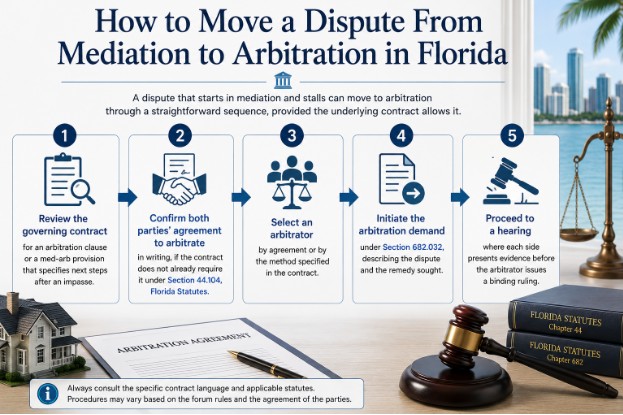
A dispute that starts in mediation and stalls can move to arbitration through a straightforward sequence, provided the underlying contract allows it.
A contract dispute that has already stalled in mediation can follow this same sequence once the underlying agreement allows it.
Property owners and businesses can review the Florida Courts’ official arbitration program page for additional detail on court-connected arbitration options.
When should I choose arbitration instead of mediation?
Arbitration tends to fit better when a contract requires it, when finality matters more than compromise, or when mediation has already reached an impasse. Mediation remains the better choice when preserving the relationship or retaining control over the outcome matters more than speed.
Is arbitration always faster than mediation?
Not necessarily. Mediation can resolve a straightforward dispute in a single session if both sides reach agreement quickly, while arbitration involves a more structured, multi-step hearing process. Arbitration is generally faster than litigation, though not automatically faster than a successful mediation session.
What are the main advantages of arbitration over mediation?
Arbitration guarantees a final ruling even if the parties cannot agree and limits the grounds for challenging that ruling to narrow statutory exceptions. Mediation produces an outcome only if both sides voluntarily accept it, and the hearing remains private in either process.
Is arbitration more expensive than mediation?
Arbitration typically costs more than mediation because it involves a structured hearing with evidence and witnesses rather than informal negotiation sessions, and total cost depends on the arbitrator’s fee, any administering-organization charges, and the number of hearing days.
Can a contract require arbitration instead of allowing mediation?
A contract can require arbitration through a written arbitration clause, which is valid, enforceable, and irrevocable under Section 682.02, Florida Statutes. When such a clause exists, it typically controls unless both parties agree otherwise.
What happens if mediation fails before arbitration is required?
If mediation ends in an impasse and the contract requires arbitration as the next step, the parties proceed to arbitration by giving notice of the arbitration demand under Section 682.032, Florida Statutes.
Does a contract have to require arbitration before parties can use it?
No. Parties can agree to arbitrate after a dispute has already arisen by signing a written submission agreement under Section 682.02, Florida Statutes, even if their original contract says nothing about arbitration. A court can also refer a contested civil action to non-binding arbitration under Section 44.103 without any prior agreement.
Does arbitration work well for construction and technical disputes?
Arbitration often fits well for construction defect claims, insurance coverage disputes, and other technical matters because the parties can select an arbitrator with relevant subject-matter experience, which mediation does not require.
Arbitration outperforms mediation when the parties prioritize a final, binding decision over a negotiated compromise — particularly when a contract requires it, the dispute involves specialized expertise, or mediation has already stalled.
Mediation still tends to fit better for ongoing relationships and lower-value disputes where both sides want to retain control over the outcome.
Which process fits a specific dispute depends on the governing contract and the circumstances involved.
A dispute that has stalled in negotiation rarely improves on its own. Parties considering arbitration can contact Miami Civil Mediator to determine whether it fits their case.

